
Partnership desk · Dubai (GST) B2B only — licensed optical retailers & distributors
English العربية
0%

Finding reliable Wholesale prescription eyeglass frames suppliers in 2026 requires more than comparing online prices. Optical retailers need frames that balance comfort, durability, style, and prescription compatibility. A low unit cost may look attractive, but weak hinges, uneven finishing, or unclear material information can create expensive returns.

This guide examines suppliers through practical buying criteria. It considers frame construction, lens-fitting support, minimum order quantities, sample policies, production capacity, and delivery consistency. It also reviews how suppliers document materials, manage quality inspections, and respond to product defects. These details matter when customers expect accurate measurements and comfortable daily wear.

Experience matters here.

A supplier may offer fashionable acetate colors, lightweight stainless steel designs, or children’s frames with flexible temples. Yet photographs cannot confirm bridge comfort or hinge strength. Requesting samples remains essential before placing a large order. Retailers should also verify prescription-related specifications with qualified optical professionals and follow applicable regional requirements.

No supplier is perfect. Even experienced manufacturers may face seasonal delays, inconsistent batches, or communication gaps. That reality deserves attention. A trustworthy partner explains limitations instead of promising flawless performance. Clear invoices, traceable product information, realistic lead times, and responsive after-sales service provide stronger evidence of reliability than promotional claims.

The following discussion highlights leading supplier types and selection factors for 2026. It aims to help optical businesses make informed, responsible decisions. Better sourcing starts with careful questions, physical testing, and honest evaluation.
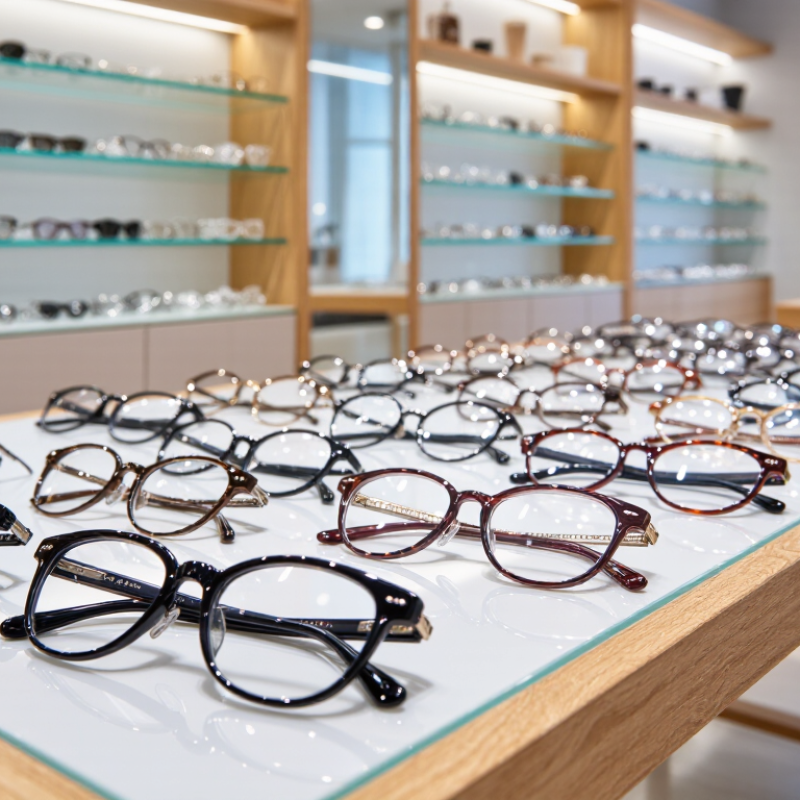
2026 Top Wholesale Prescription Eyeglass Frames Suppliers?

Global Prescription Eyewear Market Growth and 2026 Wholesale Demand Trends

2026 Top Wholesale Prescription Eyeglass Frames Suppliers?

Global prescription eyewear demand is expected to grow in 2026, supported by aging populations, screen use, and wider access to vision care. Wholesale buyers are seeking lightweight frames, adjustable nose pads, and durable hinges. Smaller lens shapes may also gain attention because they reduce material waste and suit current styling preferences. Demand remains uneven across regions, though. Forecasts are useful, not guarantees.

Reliable suppliers should provide clear material details, prescription compatibility, sample approval, and consistent production records. In practical sourcing, frame comfort often matters more than a polished catalog image. Check bridge fit, temple pressure, hinge movement, and coating resistance under normal use. Ask for batch traceability and documented quality inspections. Suppliers with responsive communication can resolve sizing or defect issues faster. However, low minimum orders may come with higher unit costs. That trade-off deserves careful review.

Tips: Request three physical samples before placing a larger order. Compare measurements with your current best-selling frames. Review packaging, labeling, and return procedures. Do not rely only on photographs. A supplier may look impressive online but perform inconsistently in production. Also, avoid overbuying one trend. A balanced mix of classic colors, flexible materials, and modern shapes can reduce inventory risk while matching changing wholesale demand.

Supplier Evaluation Metrics: MOQ, Lead Time, SKU Depth, and Defect Rates

Wholesale prescription frame sourcing in 2026 should begin with measurable supplier evidence, not attractive catalog images. MOQ affects cash flow and size testing. A practical opening order may range from 100 to 500 pieces per design, depending on customization. Ask whether MOQ applies per color, size, or complete style. The 2024 Global Eyewear Market report by Grand View Research valued the sector at approximately 129.5 billion dollars in 2023, showing strong demand but also intense supplier competition.

Lead time must include sampling, production, inspection, and shipping. Request separate estimates for repeat orders. The World Bank’s 2023 Logistics Performance Index confirms that customs and shipment tracking still vary sharply between supply markets. A supplier promising seven days may exclude molding or export handling. Get the timeline in writing. Small details matter.

SKU depth should be measured by usable options, not total listings. Check bridge widths, temple lengths, materials, colors, and prescription compatibility. The Vision Council’s 2024 VisionWatch reporting continues to show broad consumer demand across optical categories, making flexible assortment planning valuable. Defect rates require inspection records, not verbal assurance. Request the latest three-month quality report, including hinge failure, coating marks, warped fronts, and incorrect measurements. A defect rate below 2% is a useful screening target, but the calculation may exclude reworked units. That is a weakness worth challenging. Use ISO 2859-1 sampling guidance for incoming inspections, while recording your own results by shipment, SKU, and production batch.

2026 Top Wholesale Prescription Eyeglass Frames Suppliers

Anonymous supplier benchmark using four evaluation metrics: minimum order quantity, lead time, available SKU depth, and defect rate. Lower MOQ, shorter lead time, and lower defect rates indicate stronger operational performance.

Data shown as an anonymized market benchmark sample for wholesale optical-frame sourcing. Actual results may vary by material, customization level, inspection standard, and shipping destination.

Top 2026 Frame Suppliers by ISO 12870 and ANSI Z80.5 Compliance

2026 Top Wholesale Prescription Eyeglass Frames Suppliers?

Wholesale frame sourcing now depends on documented compliance, not attractive catalogs alone. ISO 12870:2016 covers spectacle-frame requirements, including construction, durability, and test methods. ANSI Z80.5-2018 provides a parallel reference for ophthalmic frames in the United States.

A reliable supplier should provide current test reports, material declarations, batch records, and traceable inspection results. Ask whether testing covers bridge strength, temple endurance, coating adhesion, and nickel release. These details matter when frames face repeated adjustments in optical stores. The World Health Organization estimates that at least 2.2 billion people have near or distance vision impairment worldwide. That scale increases the need for consistent, safe, and repairable frame production.

Grand View Research has projected continued growth in the global eyewear market through 2030, supported by prescription demand and online optical sales. Growth can hide weak quality control. I have seen polished samples fail when hinge screws loosened after routine fitting. That experience deserves attention. Suppliers should explain corrective-action procedures, inspection frequency, and rejection rates. A certificate alone is not enough. Buyers should verify its scope, testing laboratory, issue date, and exact product range. Some documentation may look complete but remain too general. Better purchasing decisions come from comparing audit evidence with physical samples and independent retesting.

2026 Top Wholesale Prescription Eyeglass Frames Suppliers? - Top 2026 Frame Suppliers by ISO 12870 and ANSI Z80.5 Compliance

Anonymous supplier qualification matrix based on product compliance evidence, wholesale capability, and buyer-verifiable documentation.

Priority Anonymous Supplier Profile ISO 12870 Evidence ANSI Z80.5 Evidence Wholesale Capability Recommended Buyer Verification Qualification Result
01 Documented Compliance Manufacturer Provides a current third-party test report identifying the tested frame models and applicable ISO 12870 requirements. Provides an applicable ANSI Z80.5 test report or equivalent laboratory evidence for the offered models. Suitable for recurring wholesale programs, private-label production, and model-level traceability. Match the report model numbers, test dates, laboratory identity, material description, and production batch records. Preferred
02 ISO-Certified Quality-System Supplier Shows a quality-management certificate and product test documentation. A quality-system certificate alone does not prove frame conformity. ANSI-related product evidence is available for selected styles or product families. Suitable for medium-to-large orders when product-level test coverage is confirmed before purchase. Confirm that the quality-system certificate covers the manufacturing site and that each ordered model is included in the test scope. Strong Candidate
03 Independent Laboratory-Test Supplier Provides independent test results for mechanical performance, construction, and durability requirements covered by the specified test program. Provides laboratory results mapped to the buyer’s requested ANSI Z80.5 acceptance criteria. Appropriate for importers and distributors that require pre-shipment inspection and sample approval. Verify laboratory accreditation, sample identification, test methods, pass/fail conclusions, and report authenticity. Qualified
04 Private-Label OEM/ODM Supplier Can arrange testing for custom designs, but compliance must be confirmed after design, material, and component changes. ANSI Z80.5 evidence is dependent on the final production configuration and cannot automatically be transferred from another model. Suitable for customized colors, temple designs, packaging, and collection development. Request a pre-production sample, bill of materials, change-control procedure, and final production test report. Conditional
05 Catalog Wholesale Supplier with Declarations Provides supplier declarations or internal inspection records without complete third-party reports for every model. Provides general conformity statements, but the scope and test methods require additional verification. May be suitable for small trial orders where the buyer accepts additional incoming inspection. Order samples, conduct dimensional and visual checks, and obtain a written corrective-action commitment. Review Required
06 Price-First Supplier without Product Test Records No verifiable ISO 12870 test documentation supplied for the proposed frame models. No verifiable ANSI Z80.5 test documentation supplied for the proposed frame models. May offer low unit prices, but compliance risk and quality variation remain difficult to quantify. Do not rely on marketing statements; require independent testing before commercial purchase. Not Recommended

Buyer Notes

  • ISO 12870 and ANSI Z80.5 are product and test-requirement references; they do not automatically certify or rank a supplier.
  • A supplier’s quality-management certificate is not a substitute for frame-level conformity evidence.
  • Compliance should be checked against the exact model, material, components, production site, and final configuration ordered.
  • For prescription eyeglass frames, confirm lens compatibility, dimensional tolerances, surface finish, hinge performance, markings, packaging, and traceability requirements separately.
Data classification: supplier screening framework and buyer-verifiable compliance criteria. Commercial terms such as MOQ, pricing, lead time, and payment conditions are supplier-specific and should be confirmed in writing before purchase.

Wholesale Price Tiers, Material Options, and Acetate Versus Metal Frames

2026 Top Wholesale Prescription Eyeglass Frames Suppliers?

Wholesale frame buying depends on price tiers, materials, and consistent quality. Entry-level frames often cost about $2–$5 per piece. They suit large, budget-focused orders. Mid-range frames usually cost $5–$10 and offer better hinges, finishing, and packaging. Premium acetate or titanium options may exceed $10 per piece. Prices change with order volume, customization, and lens compatibility.

Acetate frames feel warm and substantial in the hand. They also support rich colors, layered patterns, and polished edges. However, thicker acetate can increase weight and shipping costs. Metal frames provide a lighter profile and a cleaner appearance. Stainless steel offers practical durability, while titanium improves comfort but usually raises the wholesale price. During sample checks, inspect hinge alignment, temple flexibility, surface smoothness, and screw security. A frame can look excellent in photos but feel poorly balanced on the face. That is an easy mistake to miss.

Tips: Request samples from each price tier before placing a bulk order. Compare frame weight, bridge comfort, plating consistency, and acetate finishing under bright light. Ask for material specifications and replacement-part availability. Keep a small test record, even if it feels unnecessary. Review defect rates after delivery, not only before purchase. This feedback may reveal that the cheapest tier costs more through returns and adjustments.

Import Regulations, FDA Requirements, and Supplier Verification Checklist

2026 Top Wholesale Prescription Eyeglass Frames Suppliers: Import Regulations, FDA Requirements, and Supplier Verification Checklist

The global eyewear market reached about USD 125.8 billion in 2023, according to Grand View Research’s 2024 report. Growing demand attracts new wholesale frame suppliers. However, low prices do not prove compliance. A reliable supplier should provide company registration details, manufacturing addresses, material specifications, and traceable batch records.

For U.S. imports, prescription eyeglass frames generally fall under FDA medical-device oversight. Suppliers must confirm the correct product classification, establishment registration, device listing status, and import documentation. Check the FDA Establishment Registration and Device Listing database before placing a large order. Also review commercial invoices, country-of-origin records, harmonized tariff codes, and labeling samples. Customs descriptions should match the physical cartons. Small inconsistencies can delay clearance. The FDA’s 2024 import compliance resources remain useful, but requirements can change, so verify current rules before shipment.

Tips: Request three production samples. Measure bridge width, temple length, hinge strength, and coating quality. Ask for test reports covering nickel release, acetate composition, and child-safety concerns when relevant. Confirm whether the supplier controls production or uses undisclosed subcontractors. A video audit helps, but it is not proof by itself. I would also require a written defect policy, although many buyers overlook this step. WHO’s World Report on Vision estimates that at least 2.2 billion people have vision impairment, showing why accurate, durable eyewear matters beyond appearance.

FAQS

How should buyers evaluate a supplier before placing an opening order?

Use measurable evidence, not attractive catalog images. Review MOQ, lead time, SKU depth, defect records, and test documents. Physical samples still matter.

What MOQ is practical for testing a new frame design?

A practical opening order may range from 100 to 500 pieces per design. Ask whether MOQ applies to each color, size, or complete style. Cash flow can tighten quickly.

What details should a supplier provide about lead time?

The timeline should include sampling, production, inspection, and shipping. Request separate estimates for repeat orders. Confirm every stage in writing. Seven days may exclude export handling.

How can buyers measure useful SKU depth?

Count usable options, not total online listings. Check bridge widths, temple lengths, materials, colors, and prescription compatibility. A large catalog may still offer poor coverage.

What defect rate should a buyer consider acceptable?

A defect rate below 2% is a useful screening target. Ask how defects are calculated. Reworked units may be excluded, which weakens the comparison.

Which quality problems should inspection records include?

Request records covering hinge failure, coating marks, warped fronts, and incorrect measurements. Review the latest three months. Small marks can become store returns.

What documents should support frame safety and durability claims?

Request current test reports, material declarations, batch records, and traceable inspection results. Testing should cover bridge strength, temple endurance, coating adhesion, and nickel release. A certificate alone is not enough.

How should incoming frame inspections be organized?

Use a recognized sampling method for incoming inspections. Record results by shipment, SKU, and production batch. Compare your findings with supplier reports. Our checklist is not perfect.

How can buyers verify supplier documentation?

Check the document’s scope, testing laboratory, issue date, and exact product range. Compare paperwork with physical samples and independent retesting. Polished samples can still fail during routine fitting.

What warning signs suggest weak supplier quality control?

Watch for vague timelines, incomplete defect calculations, and general certificates. Loose hinge screws are a practical warning. Ask about corrective actions, rejection rates, and inspection frequency.

Conclusion

The 2026 market for wholesale prescription eyeglass frames is expected to be shaped by steady demand for affordable, durable, and customizable eyewear. Buyers should evaluate suppliers through practical metrics, including minimum order quantity, production lead time, SKU depth, quality-control systems, and documented defect rates. A reliable supplier should also provide clear product specifications, consistent sizing, traceable materials, and testing evidence related to ISO 12870 and ANSI Z80.5 requirements where applicable.

Wholesale pricing will generally vary by material, design complexity, finishing, and order volume. Acetate frames may offer rich colors, comfort, and design flexibility, while metal frames can provide a lightweight structure and refined appearance. Before importing, purchasers should verify labeling, documentation, FDA-related obligations for the intended market, customs requirements, and supplier registration details. A complete verification checklist should include samples, compliance records, factory information, inspection procedures, warranty terms, and written communication about delivery and product consistency.

Ethan

Ethan

Ethan is a professional marketing specialist with a strong understanding of product strategy, customer needs, and digital communication. As a key contributor to the company’s content and marketing efforts, he regularly publishes insightful blog articles that explain industry trends, practical......