
Partnership desk · Dubai (GST) B2B only — licensed optical retailers & distributors
English العربية
0%

MENA buyers need eyewear that works beyond a product photograph. Frames may face intense sunlight, high temperatures, frequent handling, and varied preferences across different markets. A polished catalogue is useful, but it cannot confirm fit, finish, or production consistency. Details matter: hinge movement, lens clarity, frame weight, color accuracy, and protective packaging. Small flaws show quickly.

This guide explores China-based manufacturers that may suit retailers, distributors, and optical businesses serving the region. It does not treat “top” as a universal ranking; the right supplier depends on product range, order volume, lead times, communication, and quality controls. A B2B eyewear manufacturer MENA buyers consider should provide clear specifications, samples, and realistic production information. Ask how defects are handled. Ask which materials and customization options are available. Verify certificates and export documentation directly, since requirements can differ by destination and product type. A supplier’s confident sales language is not proof. Neither is a beautiful sample.

The comparisons ahead focus on practical questions: Can the manufacturer support repeat orders? Are frame dimensions and finishes documented? Can the team explain packaging and shipping arrangements without vague promises? Buyers should confirm important details in writing and test samples with their intended customers. No checklist removes every risk. It helps make the decision more informed, and that is a better starting point than choosing by price alone.
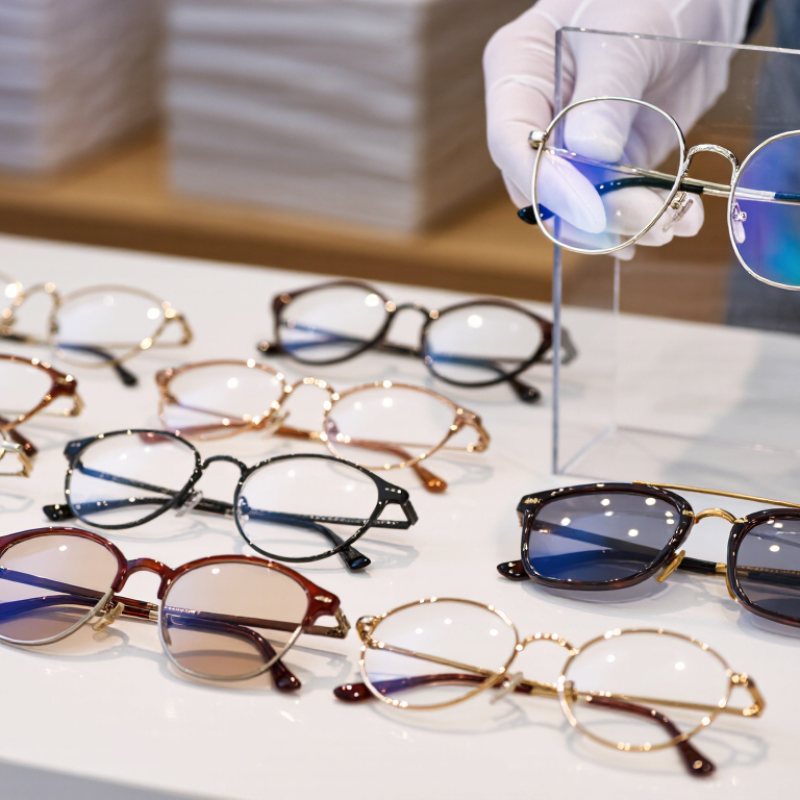
Who Are the Top China B2B Eyewear Manufacturers for MENA?

China–MENA Eyewear Trade: HS 9003 Frames and HS 9004 Sunglasses

China–MENA Eyewear Trade: HS 9003 Frames and HS 9004 Sunglasses

For MENA buyers, comparing Chinese eyewear manufacturers starts with the product category, not a sales ranking. HS 9003 generally covers spectacle frames and mountings, while HS 9004 covers spectacles and similar products, including many sunglasses. National tariff schedules may add more digits, so confirm the exact code with a customs broker in the destination market. A neat invoice is not enough.

When assessing suppliers, ask whether they can separate frame and finished-sunglass specifications, provide consistent material details, and prepare accurate packing lists and product records. Request samples that match the proposed production materials. Check hinge movement, lens tint consistency, screw fit, and finish under bright light. Small flaws show quickly.

For shipments to markets with strong sunlight and high temperatures, discuss lens performance and packaging that protects frames from heat and pressure during transit. Requirements vary by country, so verify applicable standards and labeling before placing a large order.

A factory may quote attractive prices yet offer uneven documentation or batch consistency; that deserves a careful second look. I would not treat one successful sample as proof of reliable mass production.

Manufacturer Models: Compare OEM, ODM and Private-Label Services

For MENA buyers, the service model shapes more than the frame design. It affects sample development, packaging, lead times, and how much control a buyer retains. Regional needs vary, so confirm target markets, lens specifications, and packaging expectations before requesting quotations. A useful first step is a written product brief.

With OEM production, the buyer supplies the design or detailed specifications. The manufacturer produces to that brief, including frame dimensions, materials, colors, and logo placement. This suits buyers with established designs and clear quality benchmarks. Ask for a pre-production sample. Check hinge movement, edge finishing, lens fit, and carton labeling in person where possible. Small differences matter.

ODM services use designs developed by the manufacturer, which buyers can often adapt. This may reduce design work, though available shapes and customization depend on the supplier. Private label describes selling products under the buyer’s label; it can be combined with OEM or ODM production. Not quite the same thing. Buyers should clarify ownership of artwork, packaging, and tooling in writing. They should also confirm production capacity, inspection procedures, and documentation for each destination market. A low sample price can be tempting, but it does not prove consistent bulk quality. This trade-off is easy to overlook. Request a sample from the intended production process, then compare it with agreed specifications.

Who Are the Top China B2B Eyewear Manufacturers for MENA? - Manufacturer Models: Compare OEM, ODM and Private-Label Services

Comparison dimension OEM manufacturing ODM manufacturing Private-label service
Core model The buyer supplies the design, technical specifications, or both; the factory manufactures to the agreed requirements. The manufacturer offers existing designs or product platforms that the buyer can select and customize within defined limits. An existing product is sold under the buyer’s brand, usually with agreed branding, packaging, and product options.
Design ownership and control Buyer control is typically highest when the buyer owns or licenses the design. Ownership and tooling rights should be stated in the contract. The supplier commonly retains rights to its base designs; exclusivity or changes to ownership require a specific written agreement. The underlying design is generally an existing supplier model. Brand-use permissions, exclusivity, and any custom artwork should be documented.
Customization scope Can include frame geometry, materials, colors, hinges, lenses, dimensions, logos, and packaging, subject to feasibility and tooling. Often includes selectable colors, materials, lens options, logo placement, and packaging; structural changes may require new tooling or development. Usually focuses on branding, color or lens choices from available options, and packaging rather than a new frame design.
Relative development effort Higher: specifications, samples, engineering review, and possibly tooling must be completed before production. Moderate: buyers start from an existing design, but custom changes still require review and sample approval. Lower for a standard catalog product; branding and packaging approvals still take time.
Cost and order planning Costs may include development, samples, and tooling in addition to production. Minimum order quantities depend on design, materials, and factory capacity. Existing designs can reduce initial development work, but customized components may affect cost and minimum order quantities. Often the simplest route for testing a range, but minimum quantities, packaging charges, and logo setup vary by supplier.
Typical fit for MENA buyers Suitable for buyers with established product specifications, a distinct design brief, and capacity to manage development and quality approval. Suitable for buyers seeking differentiated styles while adapting proven supplier designs to local assortment preferences. Suitable for distributors or retailers seeking branded products with a comparatively straightforward product-development process.
MENA-market checks Confirm the destination country’s applicable product rules, required test evidence, labeling language, importer details, and any design-specific requirements. Check that selected materials, lens options, product claims, and labels match the target market’s requirements; requirements differ between countries. Review brand and packaging artwork, destination-market labeling, and product documentation before authorizing mass production.
Quality and compliance evidence to request Approved drawings and samples, material specifications, inspection criteria, batch traceability, and relevant test reports for the intended product and destination. The same evidence, plus written confirmation of which design, components, and specifications are included in the selected model. The same evidence, with the buyer’s final branded sample and packaging included in pre-production approval.
Key limitation Greater control does not automatically guarantee exclusivity, compliance, or quality; these must be agreed, verified, and documented. Similar base designs may be offered to multiple buyers unless exclusivity is negotiated and clearly defined. Branding alone does not make a product exclusive or ensure that it meets the rules of every MENA destination.

Note: OEM, ODM, and private-label terms are used differently by suppliers. Confirm the exact scope, design rights, minimum quantities, lead times, inspection plan, and destination-specific compliance obligations in writing. Requirements vary across MENA markets and product categories.

Sunglass Standards: ISO 12312-1 and Lens Filter Categories 0–4

For buyers sourcing sunglasses for MENA markets, ISO 12312-1 offers a practical starting point for checking general-use eyewear. It covers performance and testing, including lens light transmission and UV-related requirements. Ask suppliers for current test reports, product markings, and batch records. A polished sample is useful, but evidence matters more.

Filter categories describe how much visible light passes through a lens. Category 0 is very light, transmitting about 80–100%; Category 1 transmits about 43–80%. Category 2 transmits roughly 18–43%, while Category 3 transmits about 8–18%. Category 4 transmits around 3–8% and is not suitable for driving. Numbers matter. A darker lens is not automatically better, and category alone does not describe UV protection or polarization.

Bright streets, pale sand, and reflective water can make Category 2 or 3 lenses useful, depending on the wearer and activity. Conditions vary across the region, so one specification may not suit every market. For procurement, confirm category labels match laboratory results and check destination-market requirements. The paperwork can look tidy. It still deserves scrutiny. A small mismatch between a sample and a production batch is easy to overlook, yet it can undermine buyer confidence.

UV Protection Benchmarks: Verify UV400 Coverage to 400 nm

For MENA buyers comparing China-based B2B eyewear manufacturers, UV protection deserves more than a label check. UV400 should indicate coverage up to 400 nanometres, including the UVA range. Dark lenses are not proof of protection. A lightly tinted lens may provide UV coverage, while a very dark one may not.

Ask suppliers for test reports that identify the lens material, sample, test method, and measured wavelength range. Check that the report supports protection through 400 nm, rather than relying on a catalogue claim or a generic certificate. Confirm that the tested sample matches the production lens, including any coating or tint. Small differences matter. If documents are unclear, request a recent independent laboratory report before approving bulk production. Keep the report with the order records for later checks.

MENA conditions make practical wear tests useful too: inspect lenses outdoors in bright sun, and check for distortion, uneven tint, or coating marks. These checks cannot replace laboratory testing. They can reveal quality issues that paperwork misses. I would also ask how the factory handles changes between sample approval and production; this detail is easy to overlook, and sometimes it is. A reliable supplier should answer clearly and provide traceable test information without treating “UV400” as a complete explanation.

Who Are the Top China B2B Eyewear Manufacturers for MENA?

UV Protection Benchmarks: Verify UV400 Coverage to 400 nm

The chart shows the commonly used UVB (280–315 nm) and UVA (315–400 nm) wavelength bands, alongside the 280–400 nm UV400 verification range. These are wavelength benchmarks, not manufacturer test results. For sourcing, request spectrophotometer data confirming UV transmittance across the claimed range.

Supplier Assessment: Compare MOQ, Lead Time, Capacity and Quality Controls

For MENA buyers, compare suppliers on the same product brief: frame material, lens type, color options, packaging, and target order volume. Ask for the MOQ per model and per color; a low model MOQ may still require large quantities for each finish. Lead times should distinguish sample approval, production, and dispatch. Request recent examples, not just an estimated number. Numbers need context.

Tips: Ask for a dated production schedule and a sample timeline. Check whether the quoted capacity reflects available lines or total factory output. During busy seasons, a supplier may not reserve the capacity you expected.

Quality controls matter as much as price. Ask how incoming materials, frame alignment, hinge movement, lens clarity, and finished-product appearance are checked. Request inspection records and agree on defect categories before production. Compare a pre-production sample with goods pulled from the finished batch. A neat sample alone proves little. If possible, review the process remotely or arrange an independent inspection. One detail buyers sometimes overlook is fit: nose-pad shape and temple pressure can affect comfort in hot weather. I would not rely on a single factory score; clear records help, but communication and repeat-order consistency also deserve scrutiny.

FAQS

What do HS 9003 and HS 9004 generally cover?

HS 9003 generally covers spectacle frames and mountings. HS 9004 includes spectacles and similar products, including many sunglasses. Check the exact code.

How can buyers confirm the correct customs code?

Ask a customs broker in the destination market to confirm the full tariff code. National schedules may add more digits. An invoice alone may not be enough.

What should buyers inspect in eyewear samples?

Check hinge movement, screw fit, lens tint, and edge finishing under bright light. Compare the sample materials with the proposed production materials. Small flaws show quickly.

How can buyers assess sunglasses for hot, sunny markets?

Discuss lens performance and packaging that can protect frames from heat and pressure during transit. Requirements vary by country, so verify applicable standards and labeling.

What is the difference between OEM and ODM production?

With OEM, the buyer provides a design or detailed specifications. ODM uses manufacturer-developed designs, which buyers may be able to adapt. Available options vary.

Is private label the same as OEM or ODM?

Not quite. Private label means selling products under the buyer’s label, and it can use either OEM or ODM production. Clarify artwork and packaging ownership in writing.

What should a product brief include before requesting quotations?

Specify target markets, lens details, frame materials, colors, packaging, and logo placement. Clear instructions can reduce misunderstandings. Still, small details are easy to miss.

Does one approved sample prove bulk quality will be consistent?

No. Request a sample made through the intended production process, then compare it with agreed specifications. Confirm inspection procedures, capacity, and product records. One good sample is not proof.

Conclusion

Choosing a B2B eyewear manufacturer MENA buyers can rely on starts with understanding the product categories involved. China’s eyewear trade includes frames classified under HS 9003 and sunglasses under HS 9004. Suppliers may offer OEM production based on buyer specifications, ODM designs ready for customization, or private-label services. Comparing these models helps buyers match design control, development needs, and sourcing goals.

For sunglasses, assess alignment with ISO 12312-1 and confirm the stated lens filter category, from 0 to 4, suits the intended use. Request evidence that lenses provide UV400 protection, covering ultraviolet wavelengths up to 400 nm. Before placing an order, compare minimum order quantities, lead times, production capacity, and quality-control procedures. Clear specifications, sample evaluations, and consistent inspection practices can help MENA buyers select a supplier suited to their market and delivery requirements.

Ethan

Ethan

Ethan is a professional marketing specialist with a strong understanding of product strategy, customer needs, and digital communication. As a key contributor to the company’s content and marketing efforts, he regularly publishes insightful blog articles that explain industry trends, practical......